Showing posts with label 20 Places to see near Hyderabad. Show all posts

Thursday, 1 August 2019

Numaish

all-india-industrial-exibition-numaish-nampally-hyderabad-Tour-Packages-serendipity-holidays-from-hyderabad-telangana-India-600-600

Website www.numaishonline.com

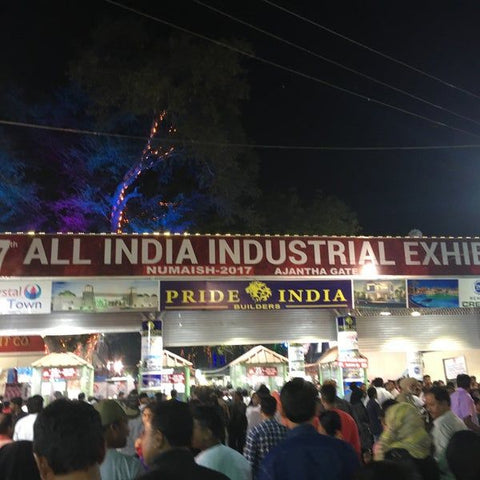
Numaish Masnuāt-e-Mulki or Numaish otherwise called Exhibition is a yearly shopper presentation held in Hyderabad, Telangana, India. The show has remained the main occasion of its sort on the planet to be composed at a stretch for a 46-day time frame at its 23-section of land (93,000 m2) changeless setting in Nampally. It highlights moonlight trips, restaurants and other diversion choices for the guests. 

History 

Numaish Masnuāt-e-Mulki meaning Exhibition of the Local Products, was begun in 1938 by a gathering of alumni of Osmania University to grandstand nearby items. It was the rule of the Last Nizam of Hyderabad, Mir Osman Ali Khan. From a simple 100 slows down in 1938 began at the Public Gardens, the setting has been moved to the Exhibition Grounds, close Nampally Railway Station. The first name was changed to All India Industrial Exhibition, and was renamed to its unique name, the Numaish in 2009. 

Toy train 

The presentation highlights dry products of the soil of Jammu and Kashmir to carefully assembled articles of clothing from Uttar Pradesh, West Bengal and Madhya Pradesh, handiwork things from all over India and electronic merchandise of the best brands in the nation. There are extraordinary slows down sorted out by various women gatherings, convicts and considerably more. The display likewise highlighted floor coverings of Iran and a few slows down from Pakistan till 2011. Be that as it may, because of strategic reasons they won't be accessible from 2012. The Hyderabadi haleem is sold by Hyderabadi eatery Pista House at the show. 

There are three section focuses: Gate No. 1 (Gandhi Bhavan Gate), Gate No. 2 (Ajanta Gate), Gate No.3 (Goshamahal Gate). The Ajanta Gate is the fundamental passageway and the greatest. 

Passage and Car leaving 

For passage to the presentation, INR30 is charged per head. 

From 2012, vehicle leaving is given fixed Rs 50 as expense for four-wheelers and Rs 20 for bikes. Also, there is a great deal of parking spot inside the presentation grounds. Vehicles are permitted passage till 4 pm. Another official parking spot has been recognized on the premises of Government Junior College, Nampally (inverse Gandhi Bhavan)6] Still there are occurrences of hoodwinking individuals in name of vehicle leaving. The rapscallions who have rented out the open grounds close to the show charge Rs 50 for a four-wheeler and Rs 20 for a bike. 

Observation 

25 CCTVs, a three-level security framework has been set up while door jamb metal indicators have been introduced at the three section areas. Aside from these, watch and ward are on obligation till 9 pm regularly during the display. Live video spilling of the Numaish with the assistance of two tilt and zoom cameras is posted on the web. From 2012, Geographical Information System (GIS) has been utilized to distribute the slows down dependent on the accessibility of the space in the grounds. 

Income 

In 2011, around 21 lakh individuals visited the presentation and the general public gathered an income of Rs 13 crore. 

Social Programs 

A few social projects are directed in the Exhibition Club during the 46-day time span that incorporate traditional and famous melodic shows, enchantment appears, mushaira (verse) and so on. As of late Bollywood and Tollywood craftsmen have likewise performed during the Numaish. 

The 75th release of the Numaish initiated on 1/1/2015 saw numerous uncommon projects in Telugu and Urdu including exhibitions by Tollywood craftsmen just as unique Ghazal projects and Comedy programs that have been gone to in enormous numbers by guests. The recently redesigned club lobby was the setting for an extraordinary tribute to Legendary artists of Urdu performed by top ghazal vocalists of Hyderabad. This was an uncommon event where such a large number of surely understood ghazal vocalists got together and performed on a similar stage. A portion of the artists whose ghazals were exhibited are Ghalib, Iqbal, Mir Taqi Mir, Faiz Ahmed Faiz, Ibn-E-Insha and that's only the tip of the iceberg. 

Games will be accessible from 6pm onwards. 

The Legendary Indian Artist, Padma Bhushan Awardee S.P. Balasubramanium was congratulated by the Exhibition Society on 8 February 2015 of every a Grand Program orchestrated by the Society's Club and Reception Sub-Committee. The President of the general public, Eatala Rajender, Telangana Minister for Finance, did the distinctions alongside the other office bearers of the general public. S.P Balasubramanium talked and adulated the administrations being rendered by the Exhibition Society. He additionally played out a couple of his numbers alongside various other Telugu Film Industry vocalists who came and executed as a tribute to Balu Sir (as he's affectionately tended to).

Monday, 29 April 2019

Hyderabad

Apr, 29

2-nights-3-days-Hyderabad-serendipity-holidays-hyderabad-telangana-tours-charminar-800x800
Hyderabad is the capital of Telangana in Southern India, situated on the banks of the Musi River and on the Deccan Plateau. Hyderabad and Secunderabad are "twin

urban communities" close Hussain Sagar Lake (otherwise called Tank Bund in nearby speech) however the two urban communities have developed so much that now they have turned out to be one major city. The city and region of Hyderabad are coterminous. Hyderabad locale is completely contained inside the Ranga Reddy region of Telangana. A significant number of suburbia of Hyderabad were as of late converged into the city, presently called Greater Hyderabad.

A city rich with history and convention, Hyderabad currently rivals Bangalore and Chennai for the crown of India's IT capital; Microsoft and Google have their India
home office here.

Get it

On the off chance that you are venturing out to Hyderabad on business — as is progressively the situation now — it is not entirely obvious the 400-year-old Hyderabad. The city that quickly hits the eye

is a rambling city of shopping centers and places of business with glass veneers. The entire of the city is by all accounts under development or remodel and the streets

are stuck in light of the fact that flyovers are being developed. It is a great city in numerous faculties.

The "old city" that was at one time the seat of the Nizam, the leader of the biggest and the most extravagant "august state", and the twin city of Secunderabad where the British

kept up a cantonment to keep the military inside striking separation of the Nizam can be seen just in the event that you take the opportunity to see them.

Hyderabad's numerous appellations incorporate the City of Pearls, the City of Nawabs, the Biryani City and, in view of its innovative draw, Cyberabad.

Via plane

Hyderabad's new Rajiv Gandhi International Airport (IATA: HYD) is found 22 km (14 mi) from the city. Note that the old air terminal at Begumpet is currently shut, with the exception of

for use by VIPs. The smooth and efficient air terminal is a standout amongst the best flying offices in India. The raised road to the airplane terminal is currently open and takes 20

minutes. Direct universal network from Hyderabad is accessible for some nations. Universal transporters working from Hyderabad are Air India, British Airways,

Emirates, Malaysia Airlines, Air Asia, Oman Air, Qatar Airways, Saudi Arabian Airlines, Silk Air, Etihad Airways, Cathay Pacific and Thai Airways.

Residential network is superb with Indian aircrafts working from here including Air India, Air India Express, Indian Airlines, Indigo Airlines, Trujet and SpiceJet.

Old city is the authentic area of Hyderabad. The majority of the verifiable attractions are arranged in the old city.

Charminar. M-Sa 9AM-5PM, shut on F 1PM-2PM for supplications. Truly "Four minarets", this structure was worked at the very spot at which Quli Qutb Shah petitioned God for the

end to the plague pandemic. The Charminar has for some time been the symbol of Hyderabad. The towers ascend to a tallness of 48.7 m over the ground. It has 140 stages. Spray painting on

the dividers have reduced the excellence of the Charminar. There is a mosque with 45 supplication spaces situated inside in the upper stories. The structure remains in the

center of a bustling street with vehicular traffic, yet a pedestrianization venture is in progress. On the minarets, you get an all encompassing perspective on Hyderabad city. At the very

base of one of the minar is a Hindu sanctuary. The traffic is not exactly perfect. Plan an early morning trip around 9 a.m. in the event that shopping isn't on your plan for the day. Rs 5, Children

beneath 11 free (for Indians), Rs 100 (for outsiders), Video cameras are charged Rs 25 additional. alter

Mecca Masjid, (SW of the Char Minar). Mecca Masjid is one of the most seasoned mosques in the city and effectively the greatest. Muhammed Quli Qutub Shah started fabricating it in

1617 under the supervision of Mir Faizullah Baig and Rangiah Choudhary. Mughal sovereign Aurangzeb finished the development in 1694. The mosque is a rock

goliath with striking innards. The primary corridor of the mosque is 75 feet high, 220 feet wide and 180 feet long, sufficiently enormous to suit ten thousand admirers at

a period. It is trusted that Muhammed Quli appointed blocks to be made with the dirt brought from Mecca and drafted them into the development of the focal

curve of the mosque, which clarifies the name of the mosque. It is obligatory for ladies to have a dupatta/shawl so as to be allowed section into the premises. 

Mecca Masjid

Chowmahalla Palace, Khilwat, 20-4-236, Motigalli, ☎ +91 40 2452-2032, . Sa-Th 10AM-5PM, shut on National Holidays. Arranged close Charminar, it was the

seat of the Asaf Jahi line where the Nizam engaged his official visitors and imperial guests. Rs 40 (for Indians), Rs 150 (for outsiders), camera grant Rs 50.

Falaknuma Palace. Worked by Nawab Viqar al-Umra in 1872, Falaknuma is a dazzling bit of engineering and the most extravagant of the Nizam's castles. The inside is

especially great and highlights crafted by Florentine stone carvers and a 100-seater Dining Table. The castle has been changed over into a lodging kept running by the Taj gathering

furthermore, is never again available to overall population.

Golconda Fort. 7AM-8PM. The Golconda Fort was the capital of the Qutb Shahi kingdom. Put aside at least 2 hr to do equity to your visit - the external divider

measures 10 km. Finding out a little about the post early is prescribed as it is anything but difficult to get confounded or lost in the gigantic space. In the event that you acknowledge one of the nearby

guides - who hustle you at the passage door - attempt to pick one who really knows his stuff (Rs 500 for each visit and the guide would likewise approach you for tips at last, in any case

it is altogether up to you whether to give tips or not), instead of somebody who was in reality simply cruising by, spotted you and will disclose to you bits he once read in a manual.

The certifiable old Muslim guide who picked up his comprehensive learning of Golconda as a newborn child from his multi year old grandma knows the historical backdrop of every last bit of

the spot and will demonstrate you with skill the reverberation/design framework incorporated with the fortification that the ruler utilized as a correspondence/spying framework. There is additionally a light

what's more, stable show - the narrative of Golkonda - for 60 minutes, which could be a little boring,(price for outsiders Rs 50/100 for typical/official ticket) after dusk enduring ~1h

that reveals to you the narrative of the fortification and merits seeing. The English show runs Nov-Feb 6:30PM every day and Mar-Oct until 7PM day by day. Hindi and Telugu indicates are run

a short time later in certain days. A short time later, have a meander through the minor lanes and shops encompassing the fortress. The wonderful scruffy old shops and houses will offer you

everything from naan bread to bangles, and the blurring and pompous old painted doors and houses are a joy, just like the inviting local people. Rs 100 all.

Qutubshahi Tombs

Qutb Shahi Tombs (1 km north of Golconda fortification, drew closer through Banjara Darwaza), . Sa-Th 9:30AM-5:30PM. The Qutubshahi mosques in Hyderabad are so

named on the grounds that they were worked by the Qutubshahi administration. The greater part of them were worked by Quli Qutb Shah, the organizer. Tragically in May 2010 neighborhood papers uncovered that

poor 'rebuilding' work supposedly utilizing incompetent work with street drills (purchased in by one government office that didn't try to look for expert exhortation or

illuminate the neighborhood archeological or condition divisions) has been harming these delightful structures. Rs 10, camera Rs 20.

Qutub Shahi Tombs Site Museum, Hyderabad-8, ☎ +91 40 2351 341. Sa-Th 9AM-4:30PM. Rs 2. a

H.E.H The Nizam's Museum, Purani Haveli, Hyderabad-2 (Behind Princess Durru Shehvar Children's Hospital), ☎ +91 40 2452 1029. Sa-Th 10AM-5PM. Home to the

popular closet of Mahbub Ali Pasha, who is said never to have worn something very similar twice. It is the world's longest closet, worked in two dimensions with a hand-turned

wooden lift(elevator) set up. This possesses the whole length of one wing of the castle. Elusive, take little street alongside Princess Durru Shehwar Hospital,

entrance door at N17 22.002 E78 28.975 Rs 50, understudies and youngsters Rs 15.

Hussain Shah Wali Dargah.

Moula Ali Dargah. 400 stairs conveys you to a position of love worked by the Asif Jahis. The Moula Ali Dargah was worked in the memory of Hazrat Ali, the child in-law of the

Prophet Muhammad. Legend has it that Yakoob, an eunuch in the court of Ibrahim Quli, went to the slope after he saw Hazrat Ali situated on it. Amazingly, he saw the

impression of Ali's palm on a stone, which he had envisioned. He had the impression removed and introduced in a hallowed place. Ibrahim Shah later assembled a mosque close to the

dargah. An Ashurkhana , a Baradari (structure) and a Nqqar khana (place for thumping drums) were worked amid the Qutb Shahi period.

Osmania Arts College. Worked amid the time of the last Nizam, Mir Osman Ali Khan. The impressive veneer of the structure is an incredible sight.

Paigah Tombs, Santoshnagar (Pisal Banda). daytime. These tombs have a place with the 'Paigah' nobles (tied by blood and marriage to the Nizams) and are around 200 years

old. These novel lime and mortar tombs are delightfully cut and have marble trim work on them. Loosening up condition with flying creature singing. N17 20.639 E78 30.248 appears to be free.

Purani Haveli, Dewandevdi (SE of Afzalganj Bridge). Sa-Th 10:30AM-5PM. Initially, the castle of the Nizam's Prime Minister, later it was revamped and turned into the quarters of the Nizam's child. It is a U-molded complex with a solitary storeyed structure in the European style. 

Raymond Tomb, Dilsukh Nagar, Asmaan Gadh. Michel Raymond, a French hired fighter, was a military authority in the administration of the second Nizam and furthermore his dear companion. His tomb is situated at Saroornagar, and is made of dark stone with excellent sky perspective on the territory alter

Salar Jung Museum, Naya Pul, Afzalgunj 

Friday, 26 April 2019

Rameswaram

serendipity-holidays-hyderabad-telangana-madurai-pamban-bridge-800x800
Rameswaram is a town in Tamil Nadu.
Get in
By plane
Nearest Airport in Madurai - 174 km Indian Airlines connect’s Madurai with Chennai, Bangalore and Mumbai.

By train
Connected with all major cities like Chennai, Coimbatore, Madurai, Trichy, Tirunelveli

By road
Connected with all important towns of Tamil Nadu, City Buses are available including night services. Point to Point services, Tourist taxi, auto / cycle rickshaws and horse carts are also available.The taxi charges for a small car (Indica) is around Rupees 10 per KM. It costs around Rupees 3800 for return trip from Madurai to Rameswaram. Andhra Pradesh State Road Transport corporation ( APSRTC ) operates Rameswaram – Tirupathi daily service.

See
Pooja procedure at the main temple

It is very important for you to know the correct procedure to offer Pooja at the main temple. Temple management allows only Hindus to perform this pooja. It is best to hire a guide a day in advance, generally around Rs 400-500 for everything. Visiting the Ramanathaswamy Temple (main temple ) involves a 4 step process:

Mani Darshanam or spatikha Linga Darshanam - You should watch the Sphatic (Natural Crystal) mani first thing in the morning at main temple. Darshan timings are 5:00 - 6:00 a.m. Some guides around Rameswaram told you that there is no need to take a bath for seeing mani dharshan , But According to Holy Scriptures of Hindus one should have to took bath before entering Temple premises, better you have a bath.
There is a special entrance for Rs 50- but it's better to stand in the general queue for Rs 10 which, counter-intuitively, moves faster.

Samudra Snanam - Next, you should walk down to Samudram(Sea) for Snanam (bathing). The sea, 300m away from the temple, is very peaceful and shallow here without any tides at all. Mythology says that Samudram surrendered to Lord Rama during his attack on Lanka and since then it is calm.
Teerth Snanam - Proceed to the temple for Teerth snanam (Holy bath). The temple has 22 wells that are said to contain holy water from different places. You need to sequentially take bath at each place. The markings are good and you can easily make out the next well.The government rate for this is Rs 25 per person. Attendants are there at each well and they will pour water on you. They splash a bucket of water on a group of pilgrims. You may need to go in queue. You can also hire attendants out side the temple for this process. But they will charge 150 rs per person. Plenty of these attendants can be found at the temple entrances with a bucket and rope in hand. If you feel like getting drenched with one full bucket of water at each well, you need to hire an attendant; otherwise, this is not required.
Main Pooja - Now you can change your clothes and dry yourself. There are different prices for different kinds of pooja. The basic one starts at Rs 111. Your guide will arrange for the Pujari (priest), who will do some rituals. Then he will offer milk, grass, leaves, etc. to Lord Shiva on your behalf in main temple. You can view all this sitting in front at a price of Rs 500. Afterwards, he will tell you the story of Rameswaram. He will also ask you to recite some shlokas after him. Pujari charges around Rs 500-600 for his services.
You can also enjoy sumptuous prasadam at 12 noon. It is offered near inner door of Lord Shiva temple.

Sri Ramanathaswamy Temple - this temple situated near the sea on the eastern side of the island is renowned for its magnificent prakaras or corridors with massive sculptured pillars on either side. The longest corridor in the world is here and it is 197 metres long from East to West and is 133 metres wide from South-North. The temple has a Gopuram 38.4 metres tall. Different rulers built the temple as it stands today, at different periods from the 12th century A.D. Pooja is performed for an hour early morning daily to the Spadikalingam that was given by the Shankaracharya to this temple. There is a popular belief that one needs to take bath in 22 theertha kundams with in the temple premises before having darshan. Locker facility is provided to tourists just outside the temple at charge of Rs.10 per locker. Shoes and footwear are not allowed inside temple. They can be deposited outside temple for free of cost. There are many guides who will approach us as soon as we enter the temple premises. One needs to negotiate the deal of how much to pay them if we need their services. It is believed that the water from these kundams have some medicinal properties. The history of the temple is linked with "Ramayan" and it is believed the the deity was installed by Lord Rama after the war with Ravana at the instance of the great saints to get rid of the "Brahma Dosham".
Agnitheertham - Sri Ramanathaswamy temple faces east. The seashore, about 100 metres from the main entrance of the temple, is very calm and therefore ideal for bathing. The water at this place is considered sacred and known as Agni theertham. Pilgrims perform poojas in honour of their ancestors at this seashore.
Gandamadana Parvatham - is a hillock situated 3 km away and is the highest point in the island. Here one can see the imprint of Lord Rama’s feet on a chakra. The entire island of Rameswaram is visible from this point.
Sugreevar Temple/Theertham - is situated on the way to Gandamadana Parvatham near the Doordarshan Kendra.
Satchi Hanuman Temple - is considered to be the place where Hanuman delivered the good news of finding Sita to Rama with satchi or evidence, Choodamani or the jewel that belonged to Sita. Situated 3 km from the main temple, on the way to the Gandamadana Parvatham.
Badrakaliamman Temple - is a temple for Devi Durga, situated 2 km from the main temple on the way to the Gandamadana Parvatham.
The Five-faced Hanuman Temple (2 km from the main temple) - the deity of Hanuman drawn withsenthooram. Idols of Lord Ram, Sita and Hanuman brought from Dhanushkodi during the 1964 cyclone were placed here. The floating stone, used to build theSethuBandanamor the bridge between India and Lanka can be found in this temple.
JadaTheertham (about 3.5 km from Rameswaram on the Dhanushkodi road) - legend has it that Lord Rama, on his way back after killing Ravana, Worshipped SriRamalinga (believed to be installed by him). Before doing so, he washed his hair(Jada) in this theertham to purify himself.
Nambu Nayagiamman Temple - is greatly venerated by the people of Ramnad District. It is situated 8 km from the main temple in Rameswaram on the way to Dhanushkodi.
Kothandaramaswamy Temple - is located 12 km away from Rameswaram. A popular belief is that Vibishana, brother of Ravana, surrendered before Rama here.
Dhanushkodi (18 km) - the southern tip of the island, Dhanushkodi was completely washed away by the 1964 cyclone. This is a strip of land about one km wide and 18 km long on the eastern end of Rameswaram island. On one side are the waters of the Indian Ocean and on the other the waters of the Bay of Bengal. The two seas otherwise known as Ratnakaran and Mahodadhi with their confluence is shaped like a bow while the strip of land resemble an arrow poised for release. Devout Hindus consider the Adi Sethu or the arrowhead, a sacred place to perform religious rites. It is also place worth visiting for its scenic beauty and bird life.
Villoondi Theertham - is situated 7 km from the main temple on the way to Pamban.
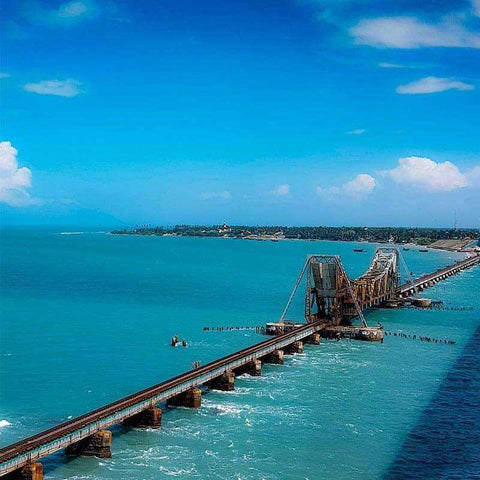
Annai Indira Gandhi Road Bridge (12 km) - is also known as the Pamban Bridge that connects the Rameswaram island with the main land. It is the longest sea bridge in India and its length is nearly 2.2 km and stands as a fine example for Indian architecture. The bridge was constructed with sufficient elevation. The islands near by and parallel rail bridge below can be viewed from this bridge.
Do
Glass boat ride at Pamban Bridge: [Update(April 2014): THIS RIDE HAS BEEN STOPPED BY THE TOURISM DEPARTMENT, HOWEVER LOOK FOR UPDATES WHEN YOU REACH PAMBAN BRIDGE. There is only one glass boat at the govt. boating center on the other end of the bridge now. That boat too is not in order, as water has entered between the two layers of glass through which you are supposed to see the corals. The boatman will tell you that the glass is not in order only when you reach the point where you are supposed to see the corals. The water is shallow there, but you won't be able to see the corals with the glass in that condition. As such, it is an utter waste of money till the govt. officials fix the boat. Even if you go there with the hope that the boat would be repaired, before boarding that single boat check the glass and ask the boatman if it is in proper condition].
One can enjoy the wonderful glass boat ride near pambanbridge to see coral reefs in the Sea. Boat has a glass bottom which enables you to see corals through it. To reach this place, you need to catch local bus from Rameswaram bus stand to Pamban bridge. From there you have to take an auto to boat center (Rs 40 - 50)(minimum 400 per boat of 8 persons), it is almost halfway on the bridge. Boat is run by Government officials and you don't have to bargain. They provide good service and don't even expect a tip from tourists. If you want to have a good view, be there between 12 noon - 1 pm on a good sunny day. Always carry an umbrella with you and watch the coral reef in umbrella shade, otherwise you'll see your own reflection on the glass instead of corals(imp: try to go for glass boat ride with a group because some days there might be no tourists there and you might end up paying more as there is no one to share glass boat ride with you) :) '

Visit Dhanushgodi: Apart from the temple this certainly is one of the best things to see and do in Rameshwaram. One can get to Dhanushgodi either by bringing their own vehicle or by using state transport or by hiring a jeep (Rs 1,300 is the going rate) or hire an auto. One can catch #3 bus from Rameshwaram to reach Dhanushgodi. Usually bus operate once in a hour. The road to Dhanushgodi was recently inaugrated by Indian prime minister Prime Minister Narendra Modi. Earlier before road was built, there used to be sand road and one had to travel via Mini truck till end of Dhanushgodi since tyres of private vehicles used to get stuck in the sand. But after the new road is built, the mini truck have been retired and tourists bring their own vehicle or come via bus. The view is amazing with sea on both sides , on one side the Bay of Bengal and on the other the Indian Ocean , the Bay of Bengal side is relatively calm and hence goes by the name (Penn Kadal , Lady Sea) and the India Ocean is rough with waves lashing and is called ( Aaan Kadal, Male Sea).
Don't forget to visit ghost town which was destroyed in the 1964 cyclone after which the city was deserted, you can see the post office , railway station , church and rail tracks in ruins. The whole trip takes about 2 hours and its best to go in the evening or early morning to avoid the scorching sun. One can also have fresh fish at roadside restaurants. These restaurants are operated by local fishermen.

Thursday, 25 October 2018

Charminar, Hyderabad

We Bet You Didn't Know These 5 Facts About Charminar
  • The Charminar is a massive arch built by Mohammed Quli Qutab Shah, in 1591 to commemorate the end of the plague in the city. The symbol of the city, the Charminar, is an impressive square monument with four minarets. The arch is illuminated daily in the evening, an unforgettable sight indeed
  • The mosque actually occupies the top most floor of the monument. The minarets are actuallythe four storey structures. Charminar is an exact squaremonument which is an ideal example of India's architectural background. ...
  • A Secret Tunnel Exists Underground That Connects The Palace At Golconda To Charminar. ...
  • Each Arch Also Has A Clock, Which Was Installed In 1889.

The Charminar ("Four Minarets"), constructed in 1591, is a monument and mosque located in Hyderabad, Telangana, India. The landmark has become a global icon of Hyderabad, listed among the most recognized structures of India. Charminar has been a historical place with mosque on the top floor for over 400 years and also known for its surrounding markets. It is one of the tourist attractions in Hyderabad. It is where many local festivals are celebrated, such as Ramzaan.

The Charminar is situated on the east bank of Musi river. To the west lies the Laad Bazaar, and to the southwest lies the richly ornamented granite Makkah Masjid. It is listed as an archaeological and architectural treasure on the official "List of Monuments" prepared by the Archaeological Survey of India. The English name is a translation and combination of the Urdu words Chār and Minar or meenar, translating to "Four Pillars"; the eponymous towers are ornate minarets attached and supported by four grand arches
Charminar, which is synonymous with Hyderabad is one of the magnificent structures built by Mohammad Quli Qutub Shah, the fifth ruler of the Qutub Shahi dynasty and also the founder of the City, in Hijri 1000 (A.D.1591-92). This is a square structure measuring 31.95 mts. on each side with imposing arches spanning a distance of 11mts. There are four minarets, each having three storeyes, rising to a height of 56 mts. The spiral staircase inside the minarets has 149 steps leading to the top with 12 landings. The double screen of arches on the roof and the ornamental arches on the minarets add to the aesthetic value.
The notable feature of Charminar is the location of a mosque on the western section of the second floor, probably one of the most beautiful of this period. There are forty-five mushallas (prayer spaces) with an open courtyard in front.
The structure is also known for its profuseness of stucco decorations and arrangement of balustrades and balconies. The floral designs are varied and delicately executed. It was a synthesis of Mughal and Hindu architecture executed by the local artisans.

There are various theories regarding the purpose for which Charminar was constructed. However, it is widely accepted that Charminar was built at the center of the city, to commemorate the eradication of plague. In the middle of the eighteenth century, Bussy the French Commander made Charminar his headquarters.
The four clocks were added later, on the four cardinal directions in the year 1889. At the base of Charminar was originally a Vazu (water cistern) at the center with a small fountain for customary ablutions, before offering prayers in the mosque.
Entrance fee: Citizens of India and visitors of SAARC (Bangladesh, Nepal, Bhutan, Sri Lanka, Pakistan, Maldives and Afghanistan) and BIMSTEC Countries (Bangladesh, Nepal, Bhutan, Sri Lanka, Thailand and Myanmar) – Rs. 15 per head & Foreigner: Rs.200/-
(Free entry for children below the age of 15)
The fifth ruler of the Qutb Shahi dynasty, Muhammad Quli Qutb Shah, built the Charminar in 1591 after shifting his capital from Golkonda to the newly formed city of Hyderabad.
Charminar, Char Kaman and Gulzar Houz, photographed by Lala Deen Dayal in the 1880's
The Archaeological Survey of India (ASI), the current caretaker of the structure, mentions in its records, "There are various theories regarding the purpose for which Charminar was constructed. However, it is widely accepted that Charminar was built at the center of the city, to commemorate the eradication of Cholera", a deadly disease which was wide spread at that time. Muhammad Quli Qutb Shah had prayed for the end of the plague that was ravaging his city and vowed to build a Mosque at the very place where he prayed. According to Jean de Thévenot, a French traveller of the 17th century whose narration was complemented with the available Persian texts, the Charminar was constructed in the year 1591 CE, to commemorate the beginning of the second Islamic millennium year (1000 AH). The event was celebrated far and wide in the Islamic world, thus Qutb Shah founded the city of Hyderabad to celebrate the event and commemorate it with the construction of this building. Due to its architecture it is also called as Arc de Triomphe of the east.
The Charminar was constructed at the intersection of the historical trade route that connects the markets of Golkonda with the port city of Machilipatnam. The Old City of Hyderabad was designed with Charminar as its centerpiece. The city was spread around the Charminar in four different quadrants and chambers, segregated according to the established settlements. Towards the north of Charminar is the Char Kaman, or four gateways, constructed in the cardinal direction. Additional eminent architects from Persia were also invited to develop the city plan. The structure itself was intended to serve as a Mosque and Madarsa. It is of Indo-Islamic architecture style, incorporating Persian architectural elements.
Historian Masud Hussain Khan says that the construction of Charminar was completed in the year 1592, and that it is the city of Hyderabad which was actually founded in the year 1591. According to the book "Days of the Beloved", Qutb shah constructed the Charminar in the year 1589, on the very spot where he first glimpsed his future queen Bhagmati, and after her conversion to Islam, Qutb Shah renamed the city as "Hyderabad". Though the story was rejected by the historians and scholars, it became popular folklore among the locals.
Qutb Shah was also among the early poets of Dakhani Urdu. While laying the foundation of Charminar, he performed the prayers in Dakhini couplets, which are recorded as follows:
Pedestrianization Project
The "Charminar Pedestrianization Project" was instituted by the then combined Government of Andhra Pradesh in partnership with the Greater Hyderabad Municipal Corporation. The project was initiated in 2006 with an investment of Rs 35 crore. Out of Rs.35 crore, the share of Central government funds stood at Rs 12.28 crore while the State government gave Rs 5.26 crore. However, the project did not see the light of day due to various factors such as Telangana movement, illegal encroachments by hawkers, vehicular traffic, and illegal street vendors. Later during January 2017, the new Government of Telangana introduced a 14-member French Delegation to takeover the project to assess the feasibility in developing the monument as an eco-friendly tourism and heritage destination. The team has inspected surrounding areas such as the Gulzar house, Macca Masjid, Lad Bazar, and Sardar Mahal. Subsequently, the project took over on a brisk pace and is expected to be completed by May 2018.
UNESCO World Heritage Site-Tentative List
Charminar, along with the Qutb Shahi Monuments of Hyderabad: the Golconda Fort, and the Qutb Shahi Tombs, were included in the "tentative list" of UNESCO World Heritage Site. The Monument was submitted by the Permanent Delegation of India to UNESCO on September 10, 2010
Read More